More Real-World Decision Scenarios
Read more

Who Actually Has Authority in Financial Oversight Decisions?


Financial oversight operates across a layered institutional landscape composed of regulators, supervisory bodies, internal risk functions, and external auditors. Authority is distributed across these entities, each responsible for specific aspects of compliance, risk management, and decision approval.
In theory, this structure provides checks and balances. In practice, it often creates ambiguity around who is responsible for authorizing decisions at critical moments.
As financial systems become more complex and interconnected, the clarity of authority becomes a central determinant of whether decisions can proceed safely and lawfully.
Most financial institutions maintain formal governance frameworks that define roles, responsibilities, and escalation paths. However, these frameworks are typically documented in policies, not enforced as operational systems.
As a result, authority is often assumed rather than verified.
Common patterns include:
These conditions create an environment where decisions may appear authorized, while lacking a verifiable chain of authority.
Failures in financial oversight rarely arise from the absence of rules. They emerge when authority structures are not aligned with the decisions being made.
Typical breakdowns include:
These failures often surface during audits, regulatory reviews, or post-incident investigations, when it becomes clear that no single authority pathway can fully explain how a decision was approved.
Delegation is a necessary feature of financial systems, but it introduces complexity when not explicitly structured.
Authority may be delegated:
Without clear mapping, delegation can lead to accountability gaps where responsibility is diffused and difficult to trace.
This creates challenges not only for internal governance, but also for regulatory reporting and external oversight.
To ensure integrity in financial decision-making, institutions must move from documented governance to verifiable authority systems.
This requires:
In this framework, authority is no longer inferred from documentation. It is computed and validated as part of the decision itself.
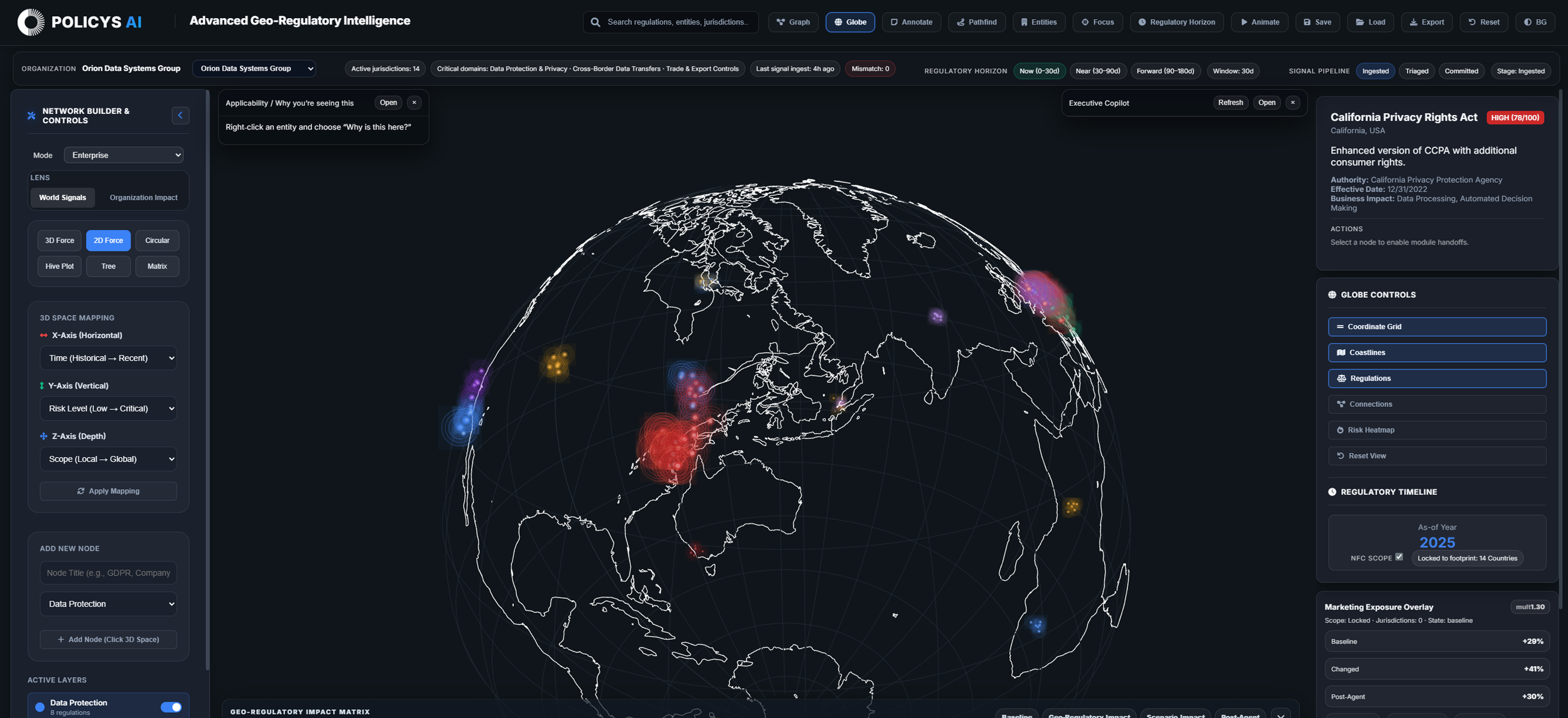
POLICYS addresses authority ambiguity in financial oversight by constructing a structured, computable model of decision rights, delegation pathways, and institutional constraints.
The system ingests internal policies, regulatory requirements, and governance frameworks to map authority across individuals, systems, and organizational units. Each proposed decision is evaluated prior to execution, verifying that it is supported by a valid chain of authority and that all delegation conditions are satisfied.
By explicitly modeling authority relationships, POLICYS identifies where decision rights overlap, where delegation boundaries are exceeded, and where escalation paths are required but not triggered. When inconsistencies are detected, the system generates remediation pathways such as rerouting approvals, adjusting delegation scopes, or introducing required oversight steps.
The result is a shift from assumed authorization to verifiable decision authority, where every financial decision is anchored to a clear, auditable chain of responsibility.