More Real-World Decision Scenarios
Read more

Can This Dual-Use Research Program Be Authorized Under Conflicting Jurisdictions?


Advanced research programs operating at the frontier of biotechnology and dual-use innovation must navigate an increasingly fragmented regulatory environment. Oversight no longer exists within a single institutional or national boundary; instead, it is distributed across multiple jurisdictions, each imposing distinct compliance obligations.
In this context, research institutions are required to reconcile:
These constraints are not static. They evolve dynamically as geopolitical conditions shift, creating latent conflicts that may not be immediately visible at the point of program design.
Dual-use research, where civilian innovation intersects with potential military or strategic applications, introduces a unique class of authorization challenges.
A program that appears compliant within one jurisdiction may simultaneously violate:
These conflicts often remain undetected until late-stage review or deployment, at which point remediation becomes costly or infeasible.
As a result, institutions face a fundamental question:
Can a research program be authorized if its compliance posture diverges across overlapping regulatory systems?
In practice, most authorization failures do not stem from a single violation, but from constraint intersections:
These interactions create cascading approval risks, where resolving one constraint may activate another.
Without structured modeling, these failure modes remain opaque to decision-makers.
To operate effectively in this environment, institutions must transition from static compliance review to computable governance systems.
This requires:
Rather than evaluating compliance retrospectively, decisions must be validated before commitment, with explicit visibility into conflicts, dependencies, and authorization pathways.
Scientific progress in regulated domains increasingly depends not only on technical capability, but on the ability to structure, validate, and authorize decisions across complex governance environments.
Institutions that adopt computable decision frameworks will be positioned to move faster without compromising compliance or oversight integrity.
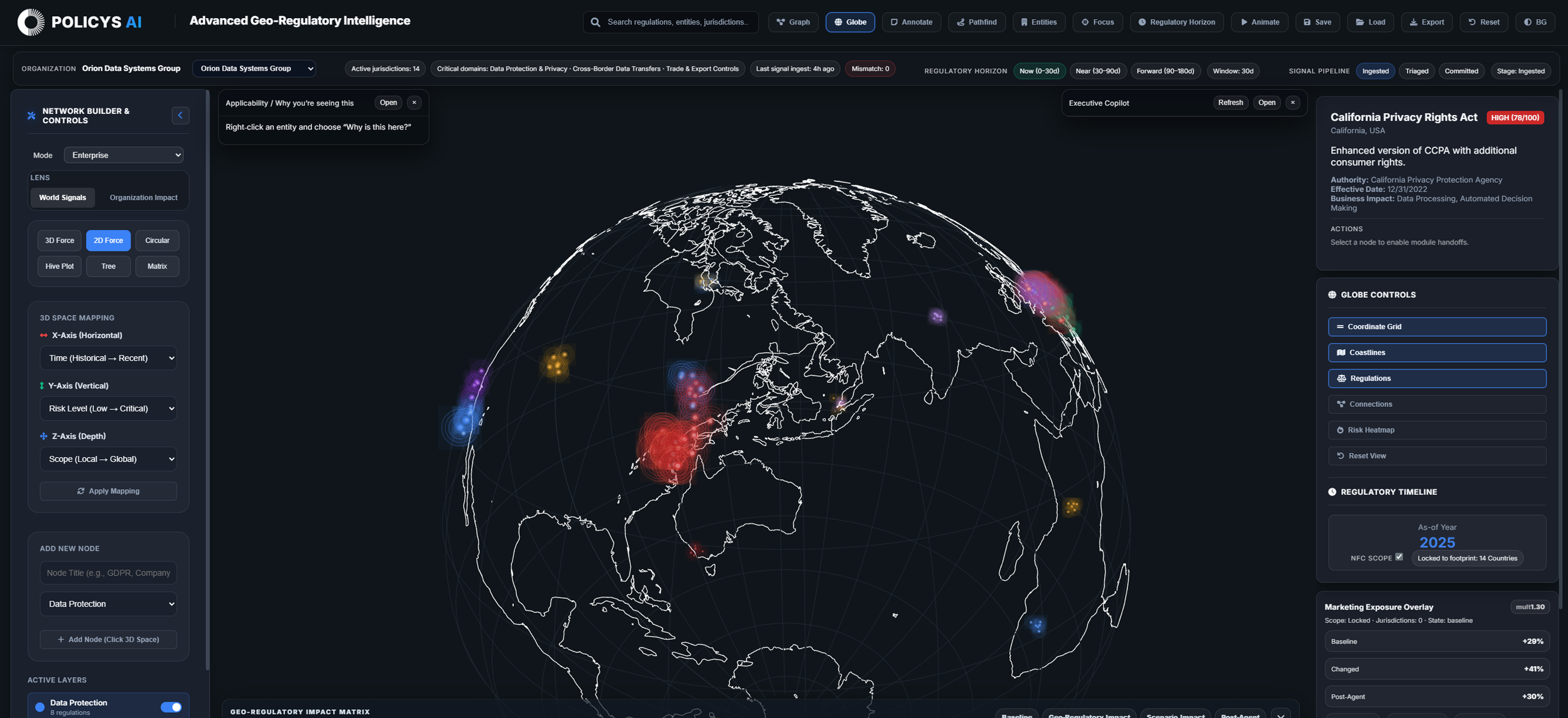
POLICYS addresses this problem by transforming regulatory and institutional constraints into a structured, computable decision layer.
Instead of relying on manual interpretation, the system ingests statutes, guidance, internal policies, and program requirements to construct a unified model of obligations, dependencies, and authority pathways. Proposed research programs are then evaluated prior to submission or execution, allowing institutions to identify cross-jurisdictional conflicts, missing approvals, and sequencing failures at the point of decision.
Where conflicts exist, POLICYS generates viable remediation pathways such as restructuring collaboration models, adjusting scope, or introducing required authorization steps, ensuring that programs can be brought into alignment with overlapping regulatory regimes.
The result is a shift from reactive compliance to decision integrity by design, where authorization is computed, not assumed.