More Real-World Decision Scenarios
Read more

How Sovereign Decision Authority Breaks in Practice


Sovereign decision-making is structured through constitutions, legal frameworks, administrative bodies, and delegated institutions. In principle, authority is clearly defined, with responsibilities assigned across branches of government and levels of administration.
In practice, sovereign authority operates across a far more complex landscape. Decision rights are distributed across ministries, agencies, regional authorities, and, in some cases, supranational organizations. These entities interact within overlapping legal and operational frameworks that are not always fully aligned.
As governance systems evolve, the gap between formal authority structures and actual decision processes becomes increasingly significant.
Failures in sovereign decision authority rarely arise from the absence of rules. They occur when formal authority structures do not align with how decisions are actually made and executed.
Common breakdowns include:
In these situations, authority becomes ambiguous. Decisions may proceed without a clear, verifiable chain of responsibility.
A central challenge in sovereign governance is institutional fragmentation.
Different entities:
This fragmentation makes it difficult to coordinate decisions that span multiple domains, such as infrastructure development, national security, or economic policy.
As a result, decisions that appear valid within one institution may be inconsistent or unworkable at the system level.
Delegation is essential in sovereign systems, allowing authority to be exercised efficiently across large and complex administrations. However, delegation introduces risk when not explicitly structured and monitored.
Authority may be delegated:
Without clear mapping of these delegation pathways, it becomes difficult to determine who is responsible for a given decision and when escalation is required.
This creates conditions where accountability is diffused and decision integrity is weakened.
Even when authority is formally defined, execution gaps can lead to decision drift.
Decision pathways may:
Over time, these deviations accumulate, creating a divergence between formal governance structures and actual operational behavior.
This divergence increases the risk of inconsistent decisions, policy misalignment, and reduced institutional control.
To maintain integrity in sovereign decision-making, governments must move toward structured systems that make authority explicit and verifiable.
This involves:
In this framework, authority is not inferred from documentation. It is structured, validated, and enforced as part of the decision process itself.
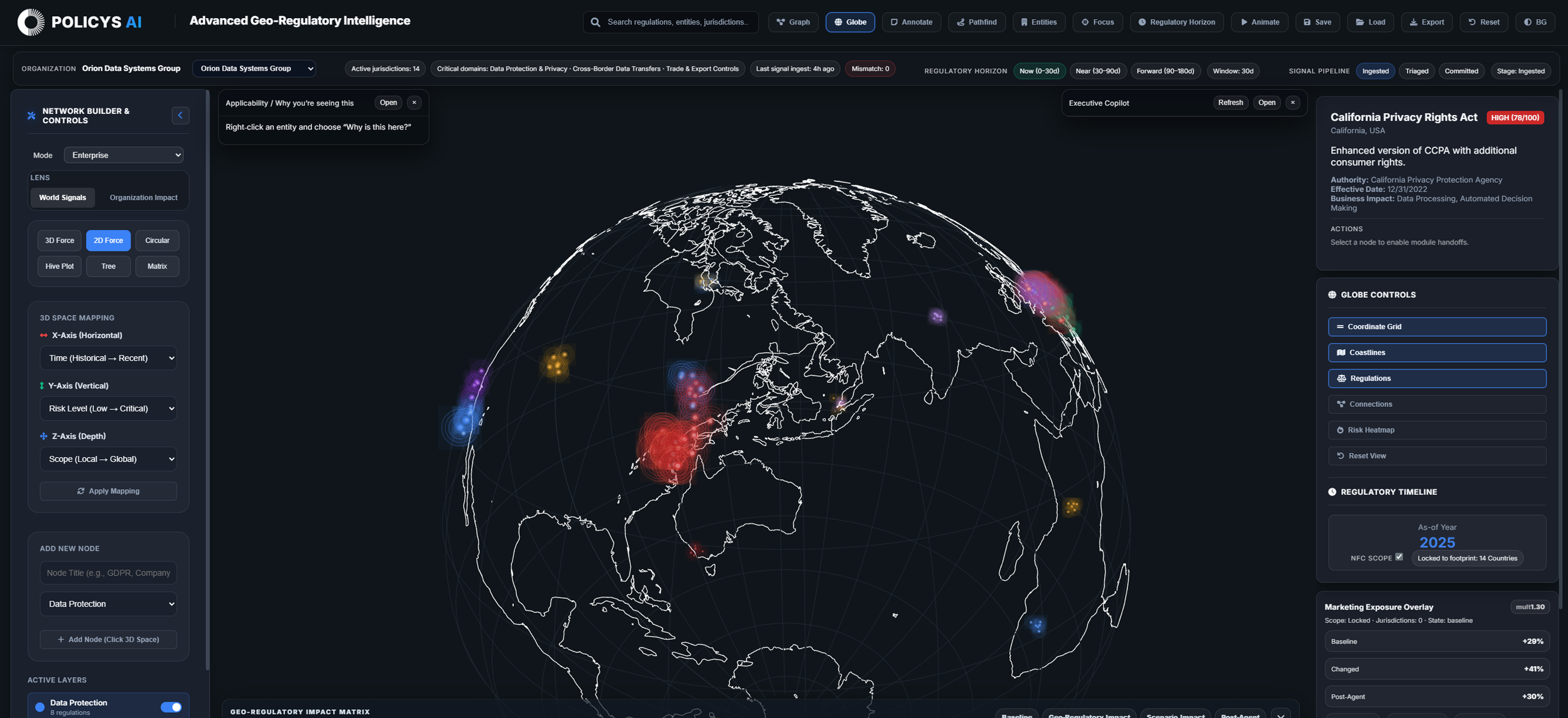
POLICYS addresses breakdowns in sovereign authority by constructing a unified, computable model of decision rights, delegation pathways, and institutional constraints.
The system ingests legal frameworks, administrative rules, and internal policies to map authority across ministries, agencies, and jurisdictions. Each proposed decision is evaluated prior to execution, verifying that it follows a valid authorization pathway and that all delegation conditions are satisfied.
By modeling how authority is distributed and exercised across institutions, POLICYS identifies where mandates overlap, where delegation boundaries are exceeded, and where escalation pathways are required but not triggered. When inconsistencies are detected, the system generates remediation pathways such as rerouting decisions through appropriate authorities, clarifying delegation scopes, or introducing required oversight steps.
The result is a shift from implicit and fragmented authority to structured, verifiable decision governance, where every sovereign decision is anchored to a clear and auditable chain of responsibility.