More Real-World Decision Scenarios
Read more

How Treaty Constraints Block Global Supply Chain Decisions
.jpg)

Global supply chains operate across a dense network of international agreements, trade regimes, and bilateral treaties that govern the movement of goods, capital, and technology. These frameworks are designed to facilitate cooperation, but they also impose constraints that shape how decisions can be made and executed.
Organizations engaged in cross-border trade must comply not only with domestic regulations, but also with treaty obligations that may introduce additional requirements, restrictions, or reporting conditions. These obligations are often embedded within broader legal frameworks and are not always visible at the operational level.
As supply chains become more complex and geopolitically sensitive, treaty constraints play an increasingly decisive role in determining whether transactions can proceed.
Supply chain decisions are frequently evaluated through the lens of operational feasibility and cost efficiency. However, treaty constraints can introduce blocking conditions that are not captured in standard planning processes.
These conditions may include:
Individually, these constraints are well-defined. Collectively, they can create situations where a transaction that appears viable becomes non-executable.
A key challenge in global supply chains is that treaty obligations do not operate in isolation. They intersect with domestic regulations, corporate policies, and contractual commitments.
For example:
These interactions create a network of constraints that must be satisfied simultaneously. Failure to account for these interactions can result in blocked transactions, delayed shipments, or regulatory violations.
Many organizations lack real-time visibility into how treaty constraints affect specific decisions. Compliance checks are often performed after key decisions have already been made, at which point options for remediation are limited.
This leads to:
The absence of early-stage validation means that organizations are frequently reacting to constraints rather than proactively structuring decisions to comply with them.
To operate effectively in this environment, organizations must move from reactive compliance to structured, treaty-aware decision systems.
This requires:
In this approach, supply chain decisions are validated in advance, reducing the likelihood of downstream failures.
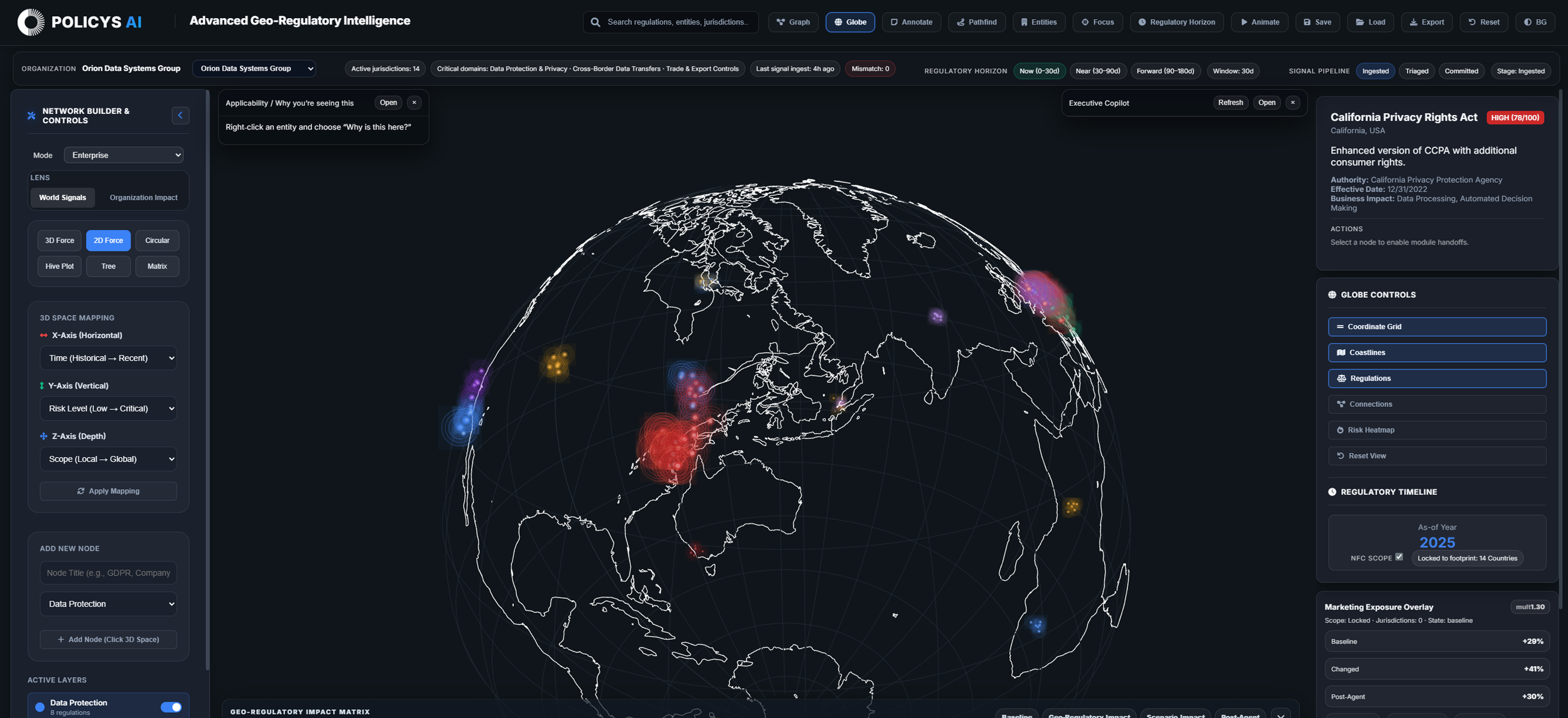
POLICYS addresses supply chain failures by transforming treaty obligations and regulatory constraints into a unified, computable decision layer.
The system ingests international agreements, sanctions regimes, trade regulations, and internal compliance policies, constructing a structured model of obligations and restrictions across jurisdictions. Proposed transactions are evaluated prior to execution, allowing organizations to detect blocking conditions, conflicting requirements, and dependency risks early in the decision process.
By modeling how treaty constraints interact with operational decisions, POLICYS identifies where transactions will be restricted, delayed, or rendered non-compliant. When issues are detected, the system generates remediation pathways such as adjusting sourcing strategies, rerouting transactions, or introducing required compliance steps.
The result is a shift from reactive compliance to pre-validated supply chain decisions, where transactions are structured to meet all applicable treaty and regulatory requirements before execution.