More Real-World Decision Scenarios
Read more

Why Do Urban Approvals Fail in High-Density Regulatory Systems?


In high-density urban environments, development approvals are governed by an intricate web of zoning codes, agency mandates, infrastructure constraints, and political oversight. What appears, on the surface, to be a procedural process is in reality a deeply interdependent system of regulatory and institutional commitments.
Projects must navigate overlapping requirements across planning departments, transportation authorities, environmental regulators, utilities, and, in many cases, multiple levels of government. Each entity operates within its own jurisdictional logic, timelines, and approval criteria.
As urban systems become denser, both physically and administratively, the complexity of these interactions increases nonlinearly.
Urban approvals rarely fail due to a single violation. Instead, breakdowns emerge from intersections between constraints that are evaluated in isolation but operate collectively.
Common failure patterns include:
These issues often remain latent during early planning stages, only surfacing after significant time and capital have been committed.
A central but under-modeled issue in urban approvals is decision sequencing.
Approvals are not simply required, they must occur in a specific order. A transportation clearance may depend on a finalized site plan; a site plan may depend on environmental clearance; environmental clearance may depend on project scope definitions that are themselves constrained by zoning interpretations.
When this sequencing is misaligned:
Crucially, these failures are rarely visible in static compliance checks. They emerge only when decisions are executed within the full system context.
Institutional fragmentation further amplifies approval risk.
Different agencies:
As a result, a project may be considered “compliant” within one agency while being structurally unapprovable across the broader system.
This fragmentation transforms approvals from a checklist exercise into a coordination problem, one that is typically managed manually and retrospectively.
To address these challenges, urban governance must move beyond document-based review toward computable approval frameworks.
This requires:
In this model, approvals are no longer evaluated as isolated steps, but as part of a dynamic system whose behavior can be analyzed prior to execution.
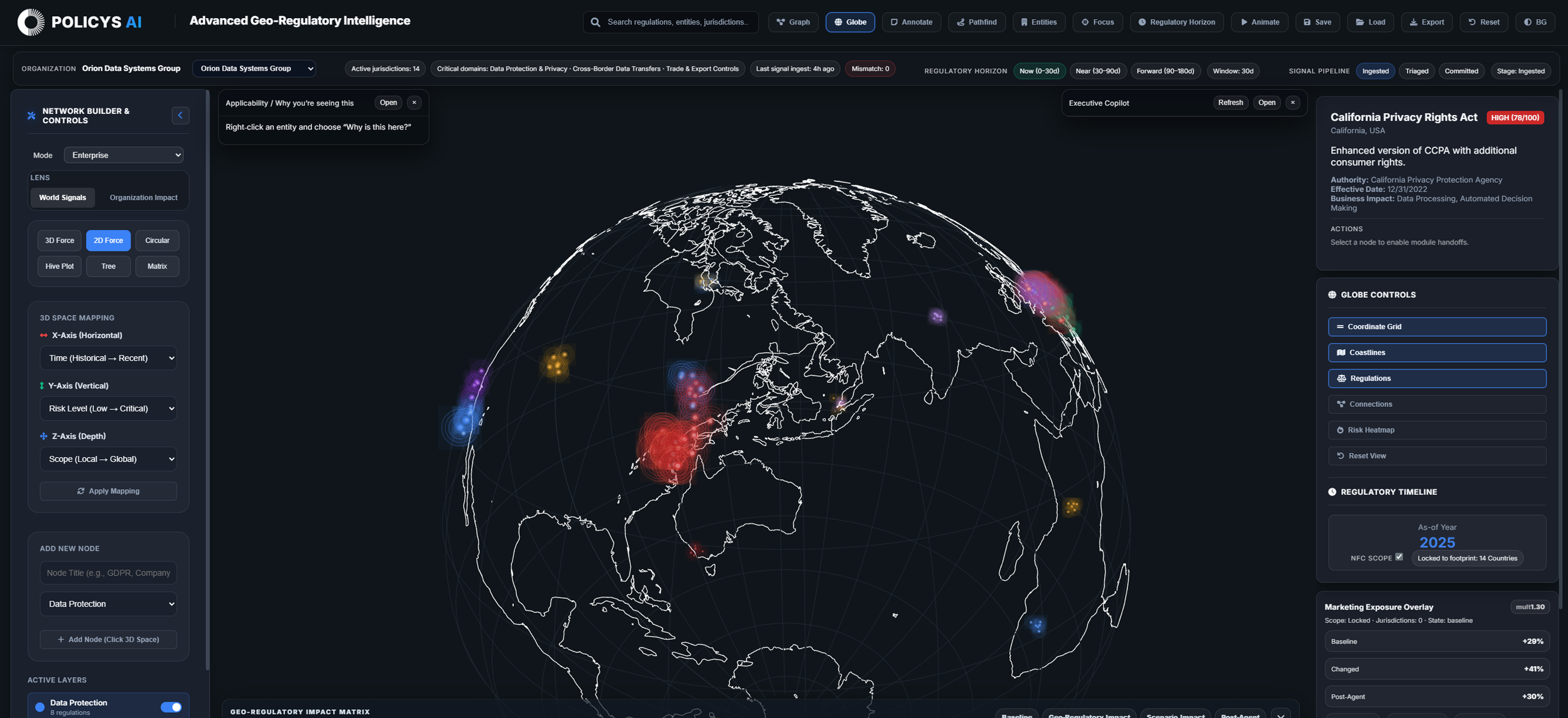
POLICYS addresses urban approval failures by converting fragmented regulatory, zoning, and institutional requirements into a unified, computable decision framework.
Instead of treating approvals as sequential administrative steps, the system models them as interconnected commitments, each governed by authority, dependency chains, and jurisdictional constraints. Proposed developments or permits are evaluated prior to submission, enabling early detection of conflicts such as misaligned zoning interpretations, missing agency approvals, or sequencing dependencies that would otherwise surface late in the process.
By simulating how decisions propagate across agencies and regulatory layers, POLICYS exposes where approvals will stall, cascade, or fail under real-world conditions. Where issues are identified, the system generates remediation pathways such as reordering approvals, modifying project parameters, or introducing required authorizations, to restore feasibility before formal review begins.
The result is a shift from fragmented, reactive approval processes to pre-validated decision pathways, where projects are structured to move through regulatory systems without unexpected breakdowns.